

Design e Função das Rodas Livres

Freewheels are machine elements with ­particular characteristics:

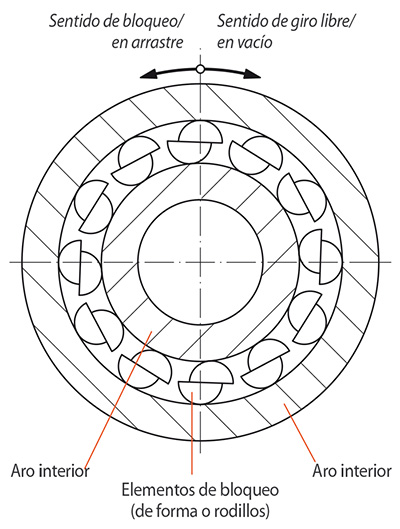
  • In one direction of rotation there is no contact between the inner and outer ring; the freewheel is in freewheeling operation.
  • In the other direction of rotation there is ­contact between the inner and outer ring; in this direction it is possible to transmit high torque.

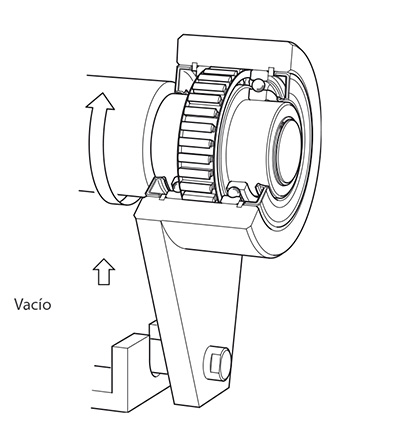
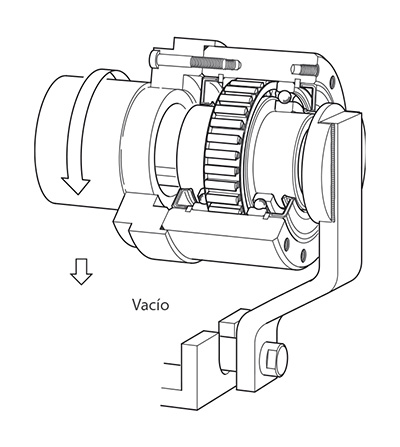
For example the outer ring of the freewheel shown in the figure beside can freewheel clockwise while the inner ring is stationary. If, however, the outer ring is turned in the opposite direction, there is contact between the inner and outer ring and the inner ring is driven (driving operation).

Freewheels are used as:

  • Backstops
  • Overrunning Clutches
  • Indexing Freewheels

Freewheels can fulfill these functions complete­ly automatically in the most diverse machines. No mechanical or hydraulic operating equipment is required, as for example with external actuated clutches or brakes.


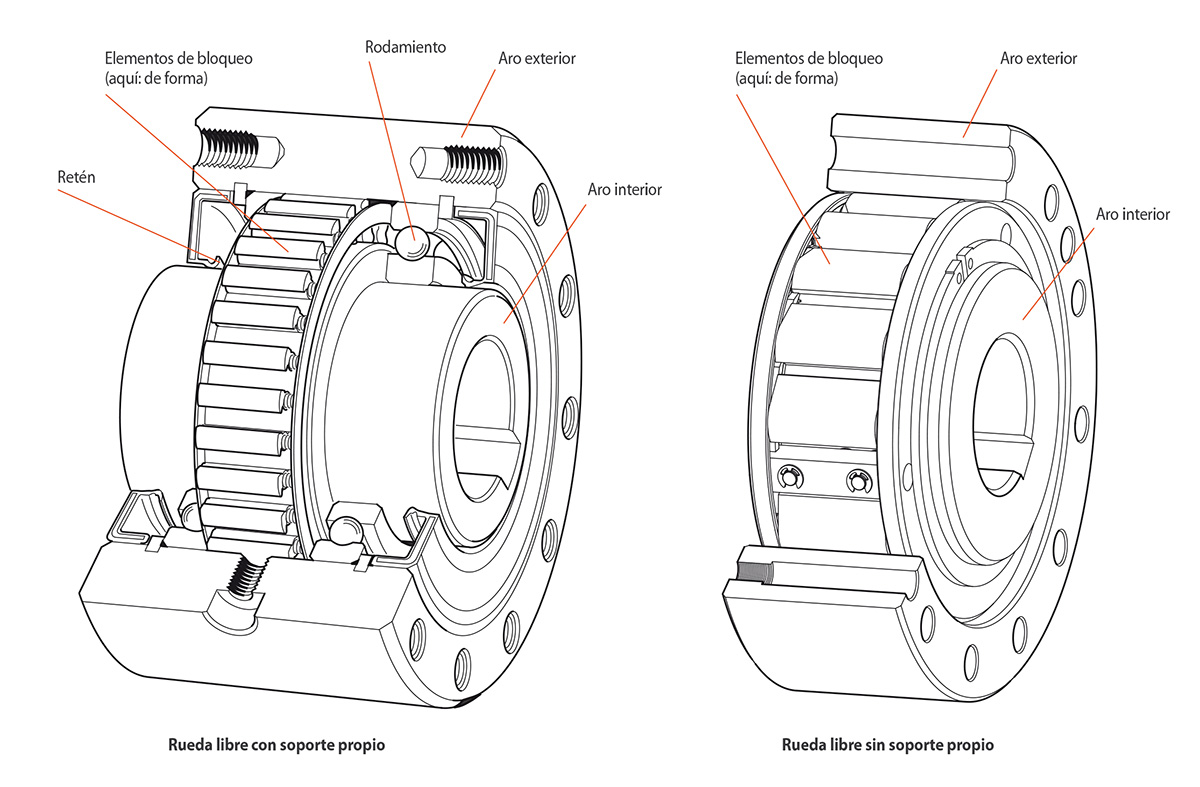
Freewheels consist of an inner and an outer ring between which clamping elements are arranged. Clamping elements can be sprags or rollers. We differentiate as follows:

  • Freewheels with bearing support and
  • Freewheels without bearing support.

For a freewheel to function, the concentric alignment of the inner and outer ring is required. In the case of freewheels without bearing support, concentric alignment like this must be provided by the customer.

RINGSPANN freewheels are an indispensable design element in the machine building industry as well as in the aerospace industry. Many designs are only economical if freewheels are used. The freewheel as an automatic driving element is preferred to conventional solutions because it offers the following significant
advantages:

  • operating safety,
  • efficiency and
  • a higher degree of automation.

With more than 50 years experience in the development, production and sales of freewheels, RINGSPANN offers the most comprehensive range of freewheels. A global network of subsidiaries and sales agencies ensures the best possible personal on-site service. Assembly and production facilities in various countries provide fast, reliable delivery.


Applications of Freewheels

Backstop

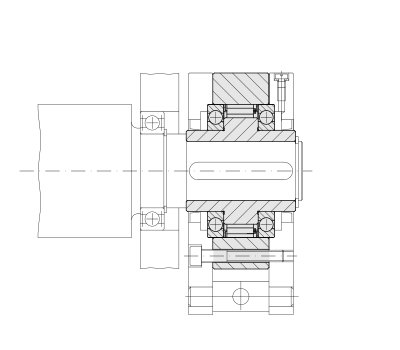
Freewheels are used as backstops if reverse rotation of the operating direction is to be prevented. In many machines and installations, for technical safety or functional reasons, it is necessary to ensure that you are working in just one specified direction of rotation. This is why there are legal stipulations requiring a mechanical safety device for the operation of, e.g. conveyor systems.

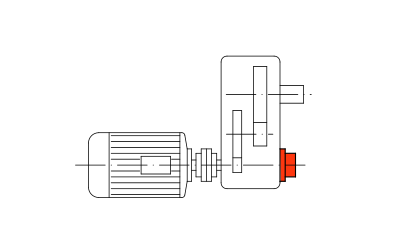
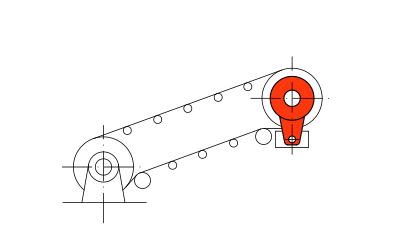
The normal operating mode of a backstop is freewheeling operation; the locking (torque transmission) is performed at zero speed. The immediate engagement of the clamping elements ensures the required high operating safety.


Habitualmente, se utilizan antirretrocesos en los que el aro interior gira libremente, mientras se bloquea el giro contrario mediante el aro exterior fijado.


En la actualidad, los antirretrocesos más sofisticados en cuanto a su diseño, en los que el aro exterior gira libremente y el bloqueo se efectúa mediante el aro interior fijado, sólo se utilizan en casos aislados.

Overrunning Clutch

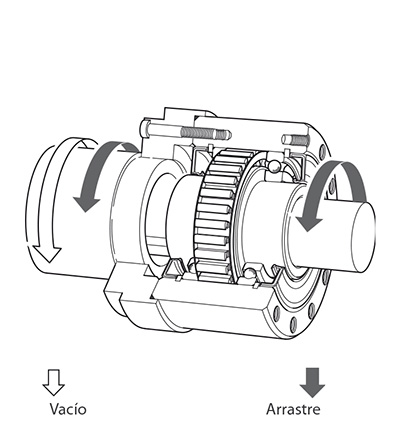
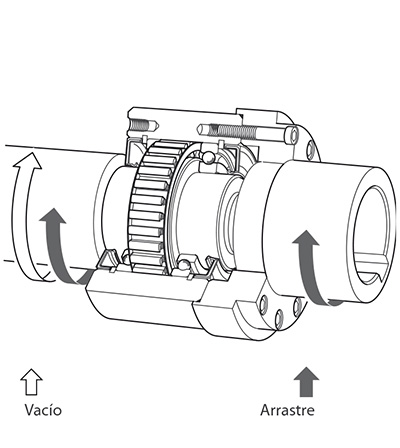
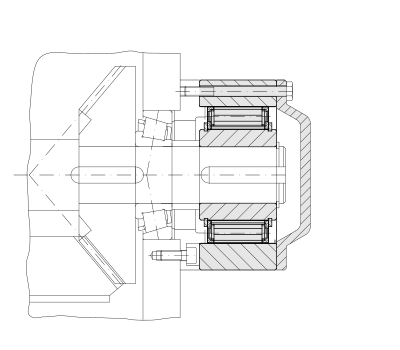
The overrunning clutch engages machines or machine parts and automatically interrupts their contact as soon as the driven part of the overrunning clutch is turned faster than the driving part. In many cases, this can replace a more expensive externally actuated clutch.

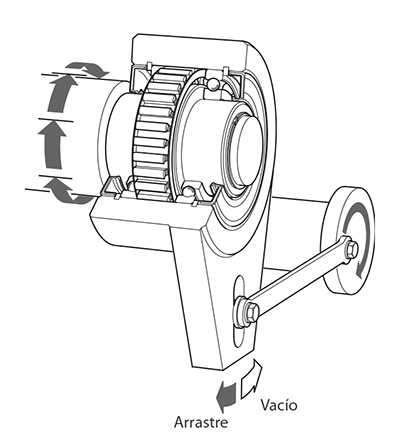
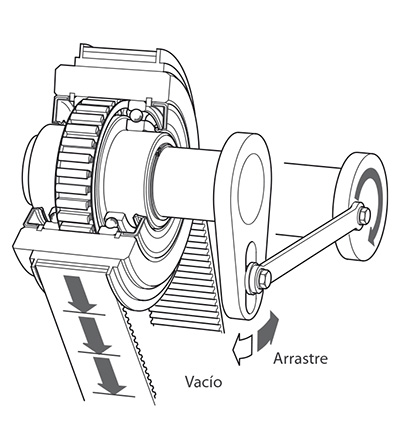
With overrunning clutches the engagement takes place in the driving operation (torque transmission), while in freewheeling operation the torque transmission between the inner and outer ring is interrupted. In ­driving operation the speeds of the inner and outer ring are equal, while in free­wheeling operation they are different.


La fig. muestra un embrague por adelantamiento, en el cual en arrastre la fuerza se transmite del aro interior al aro exterior, y en vacío el aro exterior adelanta al interior con un mayor número de revoluciones.


La fig. muestra un embrague por adelantamiento, en el cual en arrastre la fuerza se transmite del aro exterior al aro interior, y en vacío el aro interior, con mayor número de re­voluciones, adelanta al exterior.

Indexing Freewheel

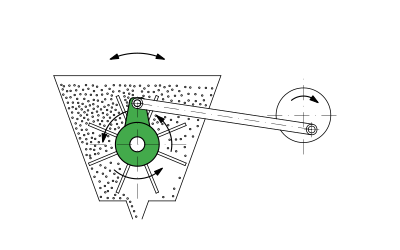
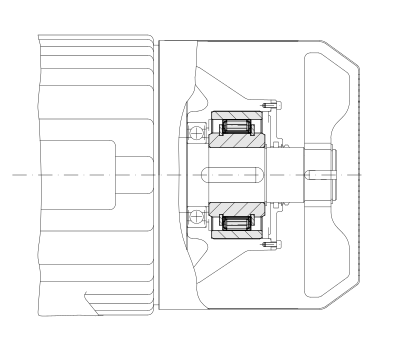
The indexing freewheel transmits a back and forth motion into a stepped rotation (indexed feed). The RINGSPANN indexing freewheel works precisely and quietly and enables an infinitly adjustable setting of the feed.


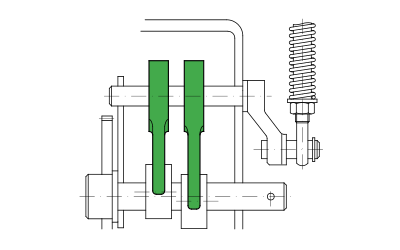
La fig. muestra una rueda libre de avance, en la que el aro exterior realiza el movimiento de vaivén y el interior el movimiento de avance paso a paso.


La fig. muestra una rueda libre de avance, en la que el aro interior realiza el movimiento de vaivén y el exterior el movimiento de avance paso a paso.

Areas of Application for Freewheels

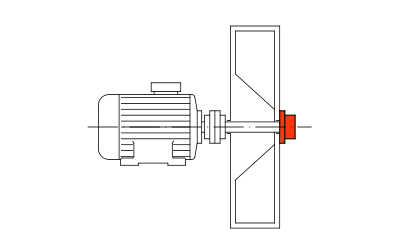
Campos de aplicación de los antirretrocesos

Gear units

Electric motors

Gear motors


The backstop prevents reverse rotation in a drive of a conveyor ­installation if the power fails or the motor is turned off.


Cintas transportadoras inclinadas

Elevadores

Transportadores de cangilones


Asimismo, el antirretroceso impide que, en caso de fallo de la red eléctrica o con el motor parado, el material transportado ­retroceda.


Fans

Ventilators


The backstop prevents reverse rotation under the back pressure of the conveyed medium if the motor is turned off.

Bombas

Compresores


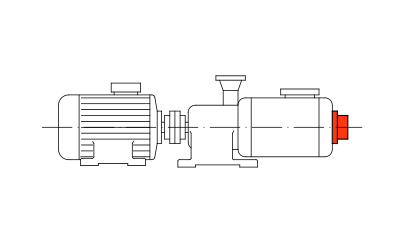
El antirretroceso impide el arranque en el sentido de giro erróneo.


Campos de aplicación de los embragues por adelantamiento

Máquinas textiles

Máquinas de imprenta


En las máquinas textiles y de imprenta, el embrague por adelantamiento desconecta el accionamiento de marcha ultralenta, que es necesario para el ajuste, del accionamiento principal.


Soplantes

Ventiladores


Al parar las soplantes o ventiladores, el embrague por adelantamiento impide que la masa de inercia de los mismos arrastre al accionamiento.


Bombas

Generadores


En los accionamientos múltiples, el embrague por adelantamiento desacopla automáticamente el accionamiento que no funciona o que funciona a revoluciones bajas.

Caminos de rodillos


Mediante el embrague por adelantamiento el material transportado se mueve por el camino de rodillos a mayor velocidad que la que correspondiese al número de revoluciones del accionamiento.


Campos de aplicación de las ruedas libres de avance

Máquinas textiles

Máquinas de imprenta


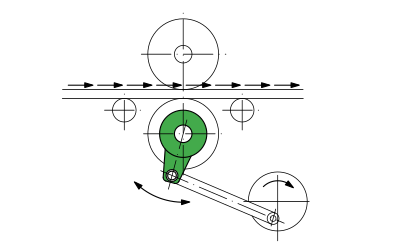
En las máquinas textiles y de imprenta, la rueda libre de avance realiza avances de transporte paso a paso.


Máquinas textiles

Máquinas de imprenta


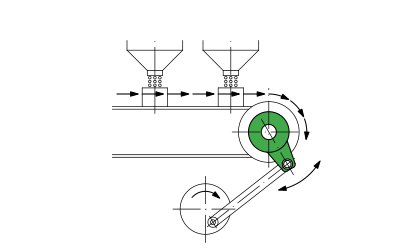
La rueda libre de avance se utiliza en las máquinas embaladoras y en las instalaciones envasadoras para realizar un avance paso a paso.


Interruptores de alta tensión


En los interruptores de alta tensión, para tensar un muelle se utiliza una rueda libre de avance en vez de un engranaje reductor.

Sembradoras


En las sembradoras, la rueda libre de avance sustituye el engranaje reductor.

Categories of Freewheels

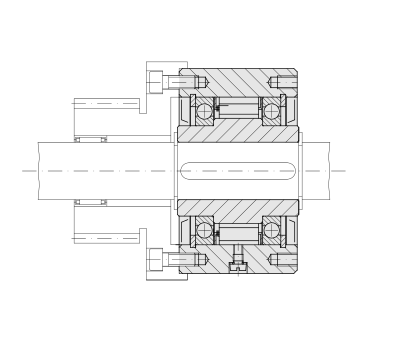
Ruedas libres completas con rodamiento

  • Con soporte propio entre los aros interior y ­exterior.
  • Completamente herméticas.
  • Con engrase propio.
  • Conexión entre el aro exterior y la pieza del cliente mediante:
    - unión atornillada en la parte frontal,
    - brida de amarre,
    - unión de chaveta por el aro exterior,
    - palanca, o
    - acoplamiento de ejes.


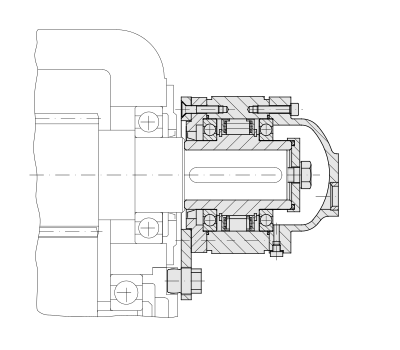
Ruedas libres con carcasa

  • Con soporte propio entre los aros interior y ­exterior.
  • Completamente encapsuladas mediante ­carcasa propia.
  • Con engrase propio.
  • Con alojamiento propio de los ejes motriz y de salida.
  • Colocación estacionaria.
 

Ruedas libres con base

  • Con soporte propio entre los aros interior y ­exterior.
  • Para completar con piezas de conexión por parte del cliente.
  • Lubricación a proveer por parte del cliente, si fuera necesaria.
 

Ruedas libres externas

  • Sin soporte propio. Alineación concéntrica de los aros interior y exterior a proveer por parte del cliente.
  • Conexión del aro exterior a la pieza del cliente mediante unión atornillada en la parte frontal.
  • Lubricación a proveer por parte del cliente, si fuera necesaria.
 

Ruedas libres incorporadas

  • Series con o sin soporte propio. En las series sin soporte propio, la alineación concéntrica de los aros interior y exterior será por parte del cliente.
  • Montaje del aro exterior en la carcasa del cliente mediante unión por ajuste a presión o unión de chaveta. Así se consiguen unas soluciones de montaje compactas, aptas para espacios ­reducidos.
  • Lubricación a proveer por parte del cliente, si fuera necesaria.
 

Acessar

Contact us


RINGSPANN IBERICA S.A.

C/Uzbina, 24-Nave E1

01015 Vitoria


+34 945 22 77-50


info@ringspann.es


www.ringspann.es

*


* *


*


*

250 / 250 characters


I accept the privacy policy *

By accepting the box you agree to receive information about our company and our news (products, catalogs ...).


 I am not a robot


* The fields marked with a star are required fields.